Value
Plural: Values
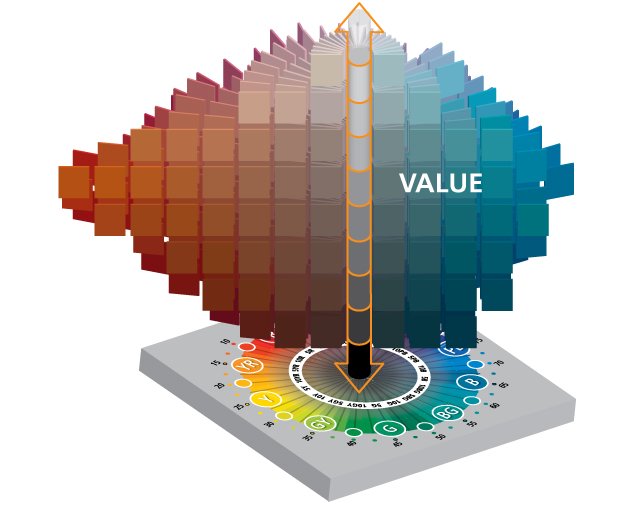
Value definition
The lightness or darkness of any color. In terms of VALUE we describe all colors as dark, middle, or light.
- The degree of lightness or darkness of a surface, independent of its hue.
- The relative position of a tone on a scale ranging from black to white.
- In painting, the primary structure that defines form, depth, and light before color is considered.
Value indicates the lightness of a color. The scale of value ranges from 0 for pure black to 10 for pure white. Black, white and the grays between them are called “neutral colors”. They have no hue. Colors that have a hue are called “chromatic colors.”
The value scale applies to chromatic as well as neutral colors.
Remember:
There are only two worlds in the values, the world of the lights (light family) and the world of the shadows (shadow family), and everything is either in one or the other. There is no other place!
People think it refers to a single specific value halfway between the shadow and highlight. Instead halftones refers as all of the values between the highlight and shadow line (or bedbug line.)
Examples
Context
Value is considered the foundation of painting. It defines structure before color becomes relevant. Even with perfect hue and chroma, a painting fails if the value relationships are incorrect.
Artists use value to:
- separate light and shadow (light family vs shadow family)
- guide the viewer’s eye through contrast
- create the illusion of three dimensional form
In many classical approaches, value is established first, and color is applied afterward.
Core Principles
- Value describes lightness and darkness, not color.
- Correct values create the illusion of three-dimensional form.
- Objects remain recognizable even if their colors change, provided their values stay accurate.
- Strong value relationships guide the viewer’s eye and improve composition.
- Value is independent of hue but closely interacts with chroma and lighting.
Derivation
From Latin valere, meaning “to be strong or to have worth.” In visual art, the term evolved to describe the “strength” or intensity of light and dark within an image.