Edge
Plural: Edges
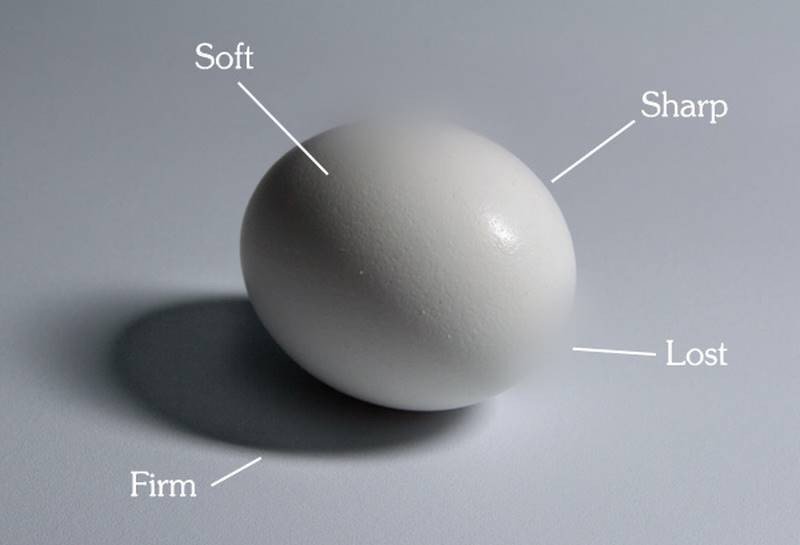
Edge definition
- An edge is the visual transition between two shapes, forms, values, or color areas.This transition does not only occur at the outer boundary of an object, but also within a form, wherever one plane, value, or color shifts into another.Edges can vary from extremely abrupt to so gradual that they disappear completely. For clarity, artists commonly group them into four main types:
- Sharp edge: an immediate change between two shapes, with no visible transition.
- Firm edge: a controlled transition with a very slight gradation.
- Soft edge: a gradual transition where one shape gently blends into another.
- Lost edge: a transition so subtle that the boundary between shapes becomes nearly or completely invisible.
Examples
The mastery of edges has been a defining characteristic of great painters throughout history. Leonardo da Vinci refined edges to the point of near disappearance through sfumato, allowing forms to emerge gradually without visible boundaries. Diego Velázquez approached edges with a deep sensitivity to atmosphere, letting forms dissolve into light and distance. Rembrandt used edges dramatically, losing and finding them to create focus, mystery, and emotional depth. Later, John Singer Sargent brought a highly selective and controlled use of edges, combining sharp accents with lost passages to guide the viewer’s eye with precision. Together, these artists demonstrate that edge control is a fundamental tool for shaping perception, focus, and meaning in painting.
Context
Edge control is one of the most powerful tools in drawing and painting. It directly affects how we perceive form, depth, focus, and atmosphere. Harder edges tend to attract attention and suggest separation, while softer edges suggest continuity, roundness, or distance.
In practice, edges are not applied mechanically but are designed. A painting becomes more convincing and expressive when edges are varied intentionally, rather than treated uniformly across the image.
Core Principles
- Edges exist both around and within forms.
- All edges fall on a spectrum from sharp to lost.
- Sharper edges attract attention; softer edges reduce emphasis.
- Lost edges occur when adjacent areas merge in value or color.
- Controlling edges helps guide the viewer’s eye and strengthen the illusion of form.
Derivation
The word edge comes from Old English ecg, meaning border or boundary. In visual art, the term evolved beyond its physical meaning to describe the visual transition between shapes and forms. Over time, artists expanded its use to include not only clear boundaries, but also subtle and even invisible transitions created by light, value, and atmosphere.