Hue
Plural: Hues
Hue definition
The distinctive primary characteristic of any Chromatic Color. In terms of HUE we describe a color as Red, Yellow, Green, Blue, or Purple.
- Hue is the attribute of color that allows it to be identified as red, blue, yellow, green, or any position along the color spectrum.
- It refers to the basic family or identity of a color, independent of its lightness (value) or intensity (chroma).
- In painting, hue is the directional axis on the color wheel that determines the color’s position relative to others.
Why not using the word “color”?
The word “color” is too broad to be useful when making or analyzing a painting. It groups together different visual qualities into a single vague idea, which makes it difficult to understand what is actually happening or what needs to be adjusted. When something feels off, saying “the color is wrong” does not point to a clear cause or solution, and this leads to guesswork instead of control.
By avoiding the generic term, you force your observation to become more precise and intentional, allowing you to see and respond to what is truly in front of you rather than relying on an imprecise label.
When people started to use the term Hue?
The term “hue” has been used for centuries, but it became more clearly defined and widely adopted between the 17th and 19th centuries, as the study of color shifted from philosophy to science.
The real turning point came with scientists like Isaac Newton in the late 1600s, who demonstrated that white light contains a spectrum of distinct colors. This pushed thinkers to start separating and naming different aspects of visual perception more carefully.
Later, in the 19th century, figures like Michel Eugène Chevreul and Hermann von Helmholtz helped formalize color theory, giving “hue” a more specific meaning as the identity of a color within the spectrum.
By the early 20th century, systems like the one developed by Albert Munsell made “hue” a standard technical term, clearly separating it from other properties of color and turning it into a practical tool for artists.
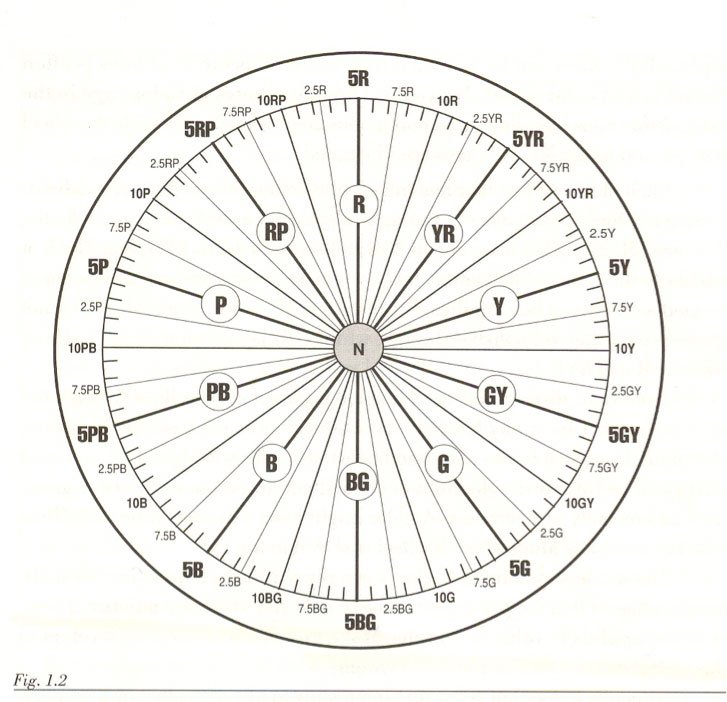
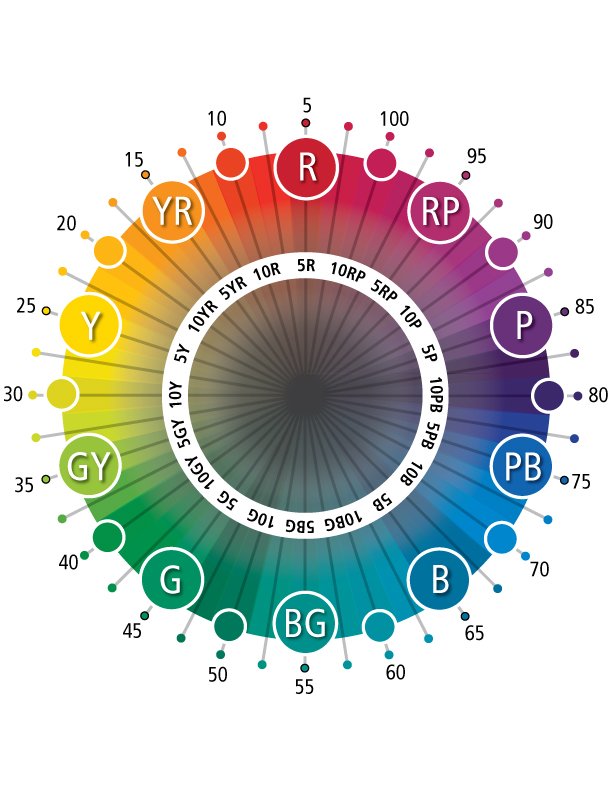
The Munsell Color Wheel
The Munsell Color Wheel comprises 10 HUE families: Red, Yellow/Red, Yellow, Yellow/Green, Green, Blue/Green, Blue, Purple/Blue, Purple, Red/Purple.
Munsell called red, yellow, green, blue, and purple “principal hues” and placed them at equal intervals around a circle. He inserted five intermediate hues: yellow-red, green-yellow, blue-green, purple-blue and red-purple, making ten hues in all. For simplicity, he used the initials as symbols to designate the ten hue sectors: R, YR, Y, GY, G, BG, B, PB, P, and RP.
Examples
Context
With Albert Munsell, “hue” became a standard teaching term, used to organize color into a structured system for painters.
Core Principles
- Hue identifies the base “color family”
- It does not describe brightness or saturation
- Small shifts in hue can dramatically change mood and temperature in a painting
- Accurate hue control is essential for realistic color mixing
Derivation
From Old English hīw meaning “appearance, form, or color,” which evolved to describe the visible quality of color itself.