Value Key
Plural: Value Keys

Value Key definition
The overall lightness or darkness of a painting.
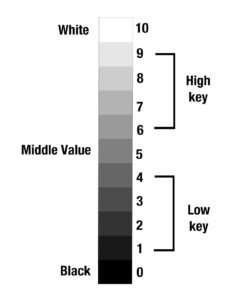 Value key is the overall tonal character of a painting or visual composition, determined by the relative predominance and distribution of light, middle, and dark values throughout the image. It describes the general degree of lightness or darkness that characterizes the composition as a whole.
A value key is established by the proportion of the composition occupied by different values and their visual relationships. It is not determined simply by the presence of the lightest or darkest passages, but by which values dominate the image and how they are distributed. A small area of deep darkness in an otherwise light composition, for example, does not necessarily make the painting low-key. Similarly, a small highlight within a predominantly dark composition does not change its low-key character.
Value keys are commonly classified into three categories:
- High-key: A composition dominated by light values.
- Middle-key: A composition dominated by middle values.
- Low-key: A composition dominated by dark values.
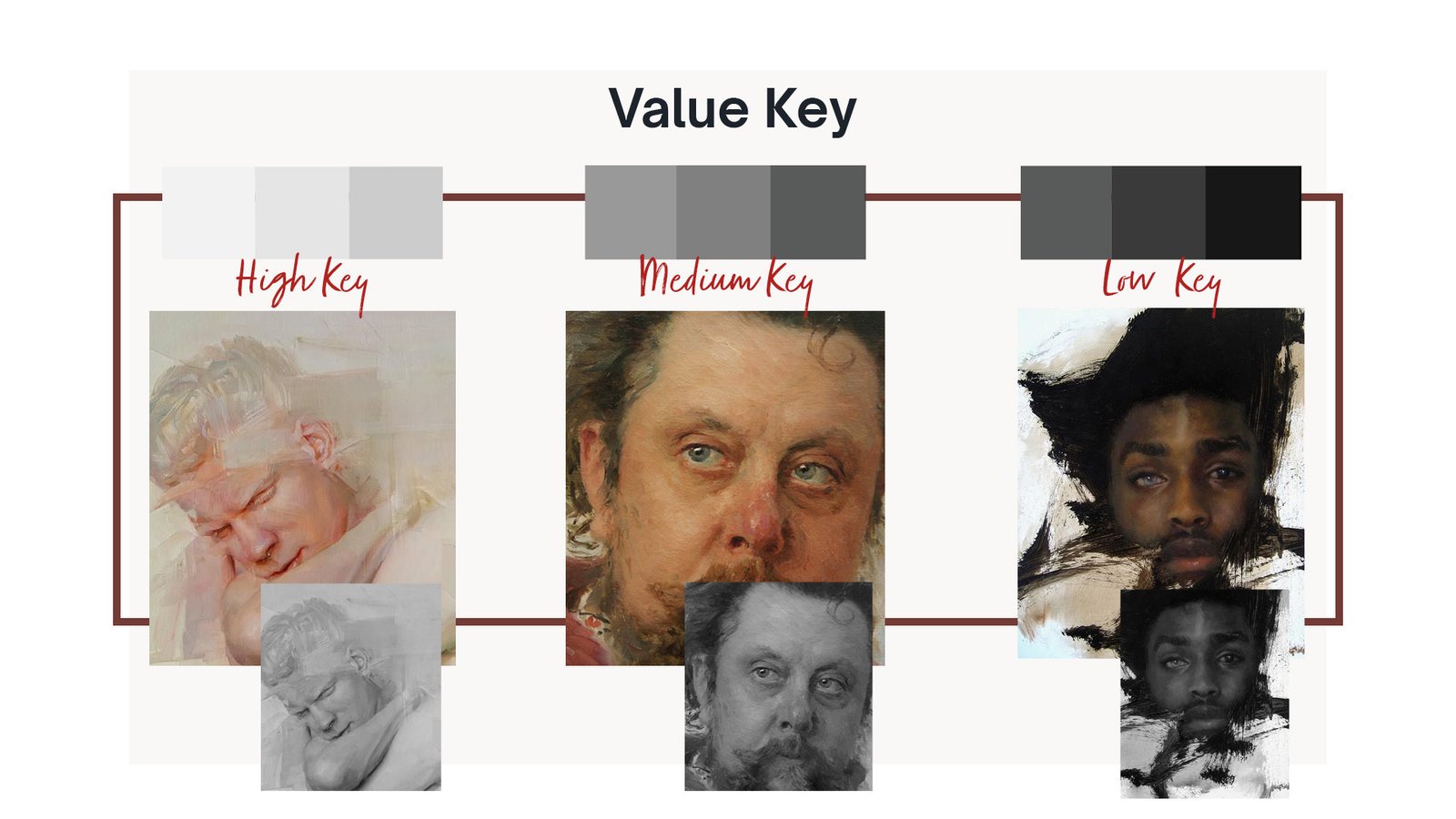
These classifications do not imply the exclusion of other values. A high-key painting can contain very dark passages, while a low-key painting can include brilliant highlights. The classification concerns the overall distribution and predominance of values, not the limits of the value range.
Value key is distinct from value range, which describes the span between the lightest and darkest values used in a painting, and value contrast, which describes the degree of difference between values. Consequently, a high-key painting can have a broad value range and strong contrast, just as a low-key painting can contain a wide range of values.
Value key is also distinct from value structure. While value key describes the overall tonal character of a composition, value structure concerns how individual value areas are organized and related to describe form, establish depth, separate elements, and create visual hierarchy.
The value key is independent of the particular hues employed. It concerns the relative lightness and darkness of colors and therefore applies equally to monochromatic and full-color paintings.
Examples
Context
Value key is an important consideration in planning a painting. It helps artists establish the overall tonal organization of a composition before developing individual forms and details. It is particularly useful in representational painting, where the distribution of light and dark values contributes to the perception of form, depth, and illumination.
Core Principles
- High-key: Light values predominate.
- Middle-key: Middle values predominate.
- Low-key: Dark values predominate.
- Value range: The span between the lightest and darkest values is independent of the value key.
- Contrast: Any value key can contain either subtle or strong contrasts.
Derivation
The term combines value, referring to the lightness or darkness of a color, and key, referring to the dominant or prevailing character of something. The expression describes the prevailing tonal character of a painting.